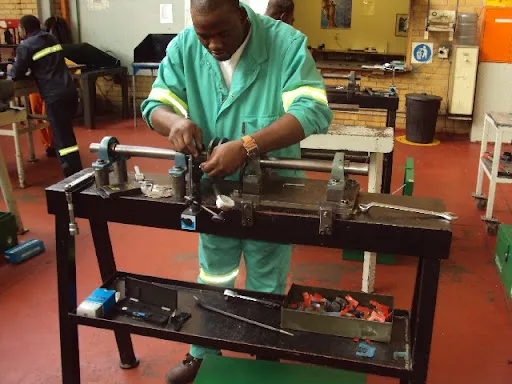
Fitting and Turning Training School
Qualify as a fitter and turner in just 1 month of intensive workshop practice at Real Skills Technical FET — lathe turning, milling, hand fitting & engineering maintenance.
Fitting and turning training at Real Skills Technical FET is a 1-month intensive workshop programme aligned to SAQA 94020 — the Occupational Certificate: Fitter and Turner, registered at NQF Level 4 by the QCTO (Quality Council for Trades and Occupations). Conducted entirely in our fully equipped engineering workshop, the course builds practical competency across all four exit-level outcomes of the qualification: applying hand skills to fabricate mechanical components, performing engineering maintenance, repairing and commissioning mechanical subassemblies, and machining components using lathes, milling machines and drilling equipment. Graduates receive a Certificate of Competence aligned to SAQA 94020 and qualify to work as fitter and turner professionals across manufacturing, mining, engineering maintenance, and heavy industry throughout South Africa.
Fitting and Turning Training — Course Overview
The fitting and turning trade combines precision engineering theory with hands-on machining and fitting skills — two complementary disciplines that together make the fitter and turner one of the most versatile and employable trades in South Africa's engineering and manufacturing sectors. Our course at Real Skills Technical FET covers both disciplines fully: the fitting side — hand skills, measuring, assembly, maintenance and repair — and the turning side — lathe work, milling, drilling, boring and thread cutting. Every day of the 1-month course is a workshop day. Theory is integrated directly into each practical task, giving you both the understanding and the hands to do the work to engineering tolerances.
Fitter and Turner — Certificate of Competence
1-month intensive workshop programme — hand fitting, lathe turning, milling, engineering maintenance & mechanical assembly
- Full 1-month workshop-based training programme
- Hand fitting: filing, scraping, drilling & reaming
- Precision measuring: micrometers, verniers & gauges
- Lathe turning: parallel, taper, boring & threading
- Milling operations: face, slot, step & angular milling
- Drilling, boring & countersinking on the drill press
- Engineering maintenance on mechanical subassemblies
- Disassembly, inspection, repair & reassembly of machines
- Reading and interpreting engineering drawings
- Calculating speeds, feeds and fits for machining tasks
- OHS Act compliance and workshop safety
- Certificate of Competence on successful assessment
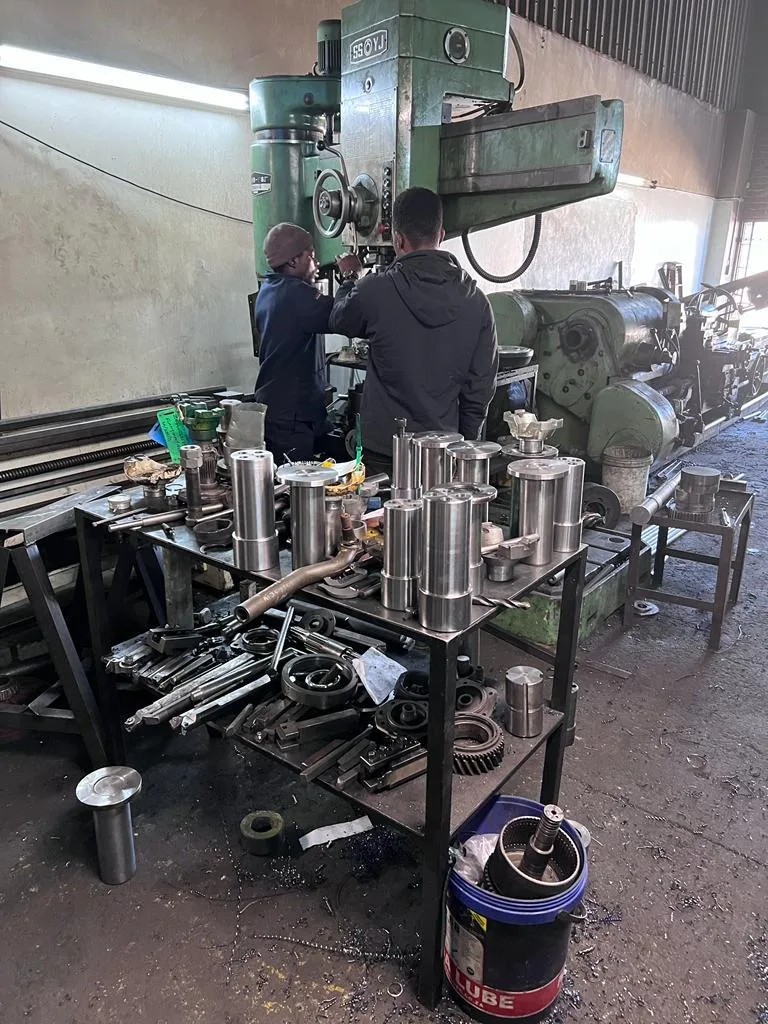
SAQA 94020 — Occupational Certificate: Fitter and Turner
SAQA 94020 is the Occupational Certificate: Fitter and Turner — registered on the National Qualifications Framework at NQF Level 4 by the QCTO (Quality Council for Trades and Occupations). A fitter and turner is a precision engineering tradesperson responsible for fabricating mechanical components using hand tools and machine tools, performing maintenance on mechanical equipment, repairing and commissioning mechanical subassemblies, and machining components to engineering drawing specifications on lathes, milling machines and drilling equipment.
The fitter and turner trade is one of South Africa's most critical engineering trades — present in every manufacturing plant, mine, processing facility, automotive production environment, and heavy engineering workshop in the country. Our course at Real Skills Technical FET covers all four exit-level outcomes of SAQA 94020, with particular emphasis on the practical machining and fitting skills that employers in manufacturing, mining, and engineering maintenance demand from qualified fitter and turner professionals.
Workshop Modules — What You Master in 1 Month
Precision Measuring
Vernier callipers, outside and inside micrometers, depth gauges, dial indicators and slip gauges — measuring to 0.01mm tolerance
Hand Fitting Skills
Filing flat and curved surfaces, scraping, hand drilling, countersinking, reaming holes to size and tapping internal threads
Engineering Drawings
Reading orthographic views, isometric projections, tolerances, fits (clearance, interference, transition), surface finishes and machining symbols
Lathe Turning
Parallel turning, facing, taper turning, internal and external threading (single-point and die), boring, parting off and knurling
Speeds & Feeds
Calculating correct cutting speeds and feed rates for different materials and operations — applying data tables and formulae to set up lathe and milling work
Milling Operations
Face milling, end milling, slot milling, step milling, angular milling — setting up the milling machine, selecting cutters and clamping workpieces
Drilling & Boring
Drill press setup, twist drill selection, drilling to layout lines, countersinking, counterboring and boring holes to specified diameter and tolerance
Thread Cutting
External and internal thread cutting on the lathe and by hand — metric and unified threads, tapping, dieing and single-point threading to drawing specification
Engineering Maintenance
Routine maintenance of mechanical components and machines — lubrication, bearing inspection and replacement, seal replacement and machine alignment
Assembly & Disassembly
Disassembling mechanical subassemblies, cleaning, inspecting components for wear and damage, replacing worn parts and reassembling to specification
Repair & Commissioning
Repairing mechanical components by machining, welding or replacement — commissioning repaired assemblies and checking against OEM specifications
OHS & Safety
OHS Act workshop safety requirements — machine guarding, chip extraction, PPE for machining, safe handling of cutting fluids and compressed air
4-Week Training Structure — Week by Week
The fitting and turning course follows a carefully structured 4-week progression — each week builds sequentially on the last, moving from foundational hand skills and measuring through to precision lathe work, milling, and the final trade competency assessment.
Week 1 — Hand Fitting Skills, Measuring & Engineering Drawings
Week 1 Workshop Programme
- OHS Act & Machine Shop Safety: Legal framework governing engineering workshop safety — machine guarding requirements, PPE for machining, safe handling of cutting tools, chip extraction, cooling fluids, and compressed air safety
- Precision measuring instruments: Using and caring for vernier callipers, outside micrometers, inside micrometers, depth gauges, dial test indicators and slip gauges — reading to 0.01mm and 0.001" accuracy, zeroing instruments and checking for calibration
- Engineering drawings — fundamentals: First-angle and third-angle orthographic projection, section views, auxiliary views — reading dimensions, tolerances, fits and surface finish symbols; identifying machining operations from drawing notes
- Fits and tolerances: Understanding clearance fits, interference fits and transition fits — applying ISO tolerance grades (H7/g6, H7/p6 etc.) from data tables to determine acceptable machining limits for shafts and bores
- Filing operations: Single-cut and double-cut files — flat filing to a scribed line, draw filing to produce a smooth surface, cross-filing to remove material quickly, and checking flatness with a surface plate and engineer's blue
- Hand drilling and tapping: Twist drill selection and grinding, centre punching and drilling to layout lines, countersinking and counterboring, tapping metric and unified internal threads by hand — checking thread with plug gauge
- Reaming and scraping: Hand reaming drilled holes to close tolerance — selecting reamer size relative to drill size, reaming technique and checking with pin gauges. Surface scraping to improve fit and flatness on machined surfaces
Week 2 — Lathe Turning Operations
Week 2 Workshop Programme
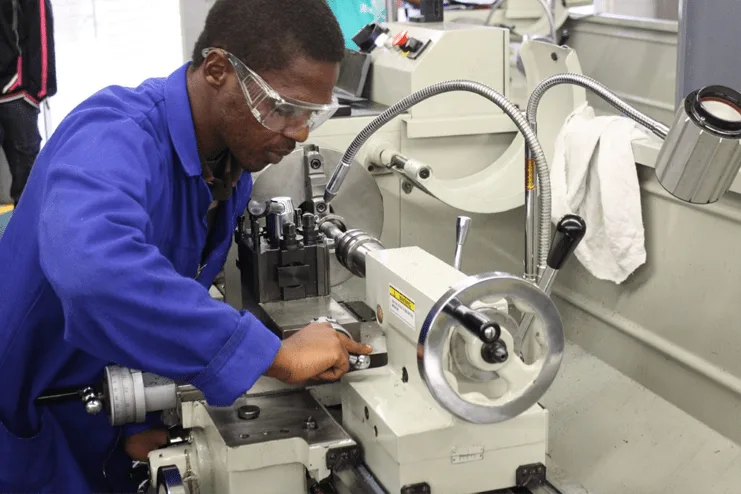
- Lathe machine introduction and safety: Major components of the centre lathe — headstock, tailstock, carriage, cross-slide, compound rest and apron. Safe operating procedures: guarding, chuck key discipline, setting tool height and securing the workpiece correctly before starting
- Speeds and feeds — applied: Calculating correct spindle speed from cutting speed (Vc) and workpiece diameter using the formulae. Feed rate selection for roughing and finishing cuts. Setting lathe speeds and feed rates for mild steel, stainless steel, cast iron, brass and aluminium
- Parallel turning and facing: Setting up turning tools, taking roughing cuts, finishing to diameter, facing the end of a workpiece flat, turning to a shoulder and checking dimensions using micrometers and verniers at each stage
- Taper turning: Setting over the tailstock method for long external tapers, using the compound slide for short tapers — calculating tailstock offset and compound angle from drawing specifications, checking taper with a taper gauge
- Boring operations on the lathe: Setting up boring bars, boring a pre-drilled hole to a specified diameter and depth — boring to produce clearance and interference fits, measuring bore with inside micrometer and dial bore gauge
- External and internal threading: Setting up the lathe for single-point thread cutting — selecting correct gearing for metric and unified threads, threading to a shoulder, using a threading dial, and checking with thread gauge and mating nut or bolt
- Parting off and knurling: Using a parting-off tool to cut components from bar stock — setting correct speed and feed for parting, applying coolant. Diamond and straight knurling for grip surfaces — tool setup and checking knurl pattern quality
Week 3 — Milling, Engineering Maintenance & Repair
Week 3 Workshop Programme
- Milling machine introduction and safety: Components of the vertical and horizontal milling machine — column, knee, saddle, table, spindle and arbor. Safe setup procedure: securing the workpiece in the vice, checking for parallels, setting the cutter height and selecting climb vs conventional milling for each operation
- Face milling and end milling: Face milling a flat surface to a specified dimension and surface finish, end milling to produce steps and shoulders — selecting face mills and end mills for the material, setting depth of cut, speed and feed
- Slot and keyway milling: Milling a slot or keyway to drawing specification using a slot drill or end mill — setting up a dividing head for indexed keyway positions, measuring slot width and depth with slip gauges and feeler gauges
- Angular and form milling: Using angle cutters and form cutters for dovetail slots, T-slots and angular faces — setting the milling table to the required angle, calculating cutter approach and exit paths to avoid interference
- Drill press operations: Setting up the drill press — work clamping, selecting and fitting twist drills, core drills and stepped drills, setting spindle speed, drilling to layout and to jig, countersinking, counterboring and spotfacing
- Engineering maintenance of mechanical components: Routine maintenance tasks on mechanical subassemblies — lubrication schedules, bearing condition assessment, belt and chain tension checks, coupling alignment, and seal replacement. Documenting maintenance tasks on a job card
- Disassembly, inspection and repair: Systematically disassembling a mechanical subassembly — cleaning components, inspecting for wear, scoring, cracking and dimensional deviation, identifying components requiring replacement, selecting replacement parts and reassembling to OEM specification
Week 4 — Assembly, Commissioning & Final Assessment
Week 4 — Assessment Programme
- Complete component machining task: Candidates independently machine a component from a drawing — involving parallel turning, facing, boring or taper turning, and external or internal threading — to within the dimensional tolerances specified on the drawing
- Hand fitting task: Candidates produce a fitting exercise — filing to a scribed layout, drilling and tapping holes, hand reaming and producing a close-fitting assembly — demonstrating surface quality and dimensional accuracy assessed against specification
- Milling task: Candidates complete a milling exercise producing a component with flat surfaces, a slot and a step — demonstrating correct machine setup, cutter selection, speed and feed settings and dimensional control
- Mechanical subassembly repair and commissioning: Candidates disassemble a mechanical subassembly, identify and replace or repair a specified defective component, reassemble to specification, check alignment and clearances, and commission the assembly — verifying correct operation against OEM data
- Dimensional inspection: All machined components are inspected against drawing tolerances using micrometers, verniers and gauges — candidates demonstrate correct instrument selection and reading, and identify any deviations from specification
- Trade assessment — SAQA 94020: Full competency assessment covering all four exit-level outcomes — hand fabrication, engineering maintenance, repair and commissioning, and machining — assessed by a qualified assessor as Competent or Not Yet Competent
- Certificate of Competence issued: Successful candidates receive their Certificate of Competence aligned to SAQA 94020, issued by Real Skills Technical FET — qualifying them as fitter and turner professionals recognised across South Africa's manufacturing, mining and engineering sectors
Book Your Fitting and Turning Training
1 month. R10,000. SAQA 94020. Full workshop practice — lathe, milling, hand fitting & maintenance. Certificate of Competence. Free accommodation.
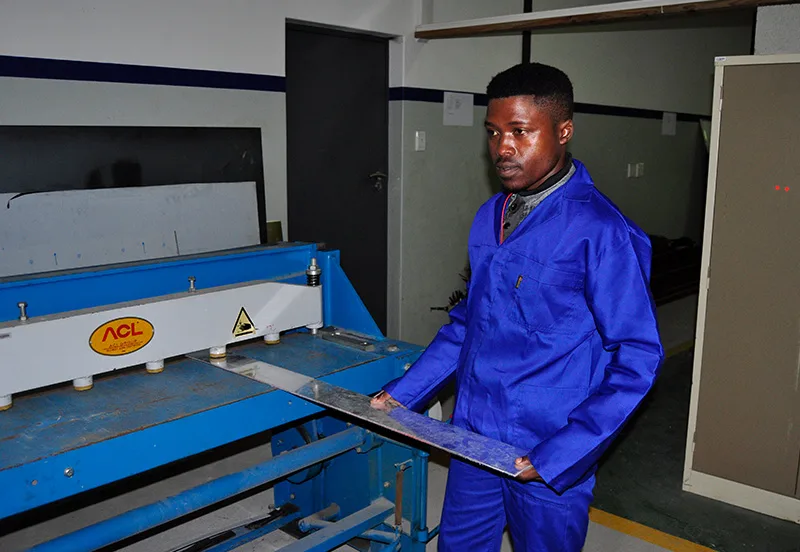
Your Credential on Completion — Fitter and Turner Certificate of Competence
Candidates who achieve competency across all four exit-level outcomes of the assessment receive a formal credential from Real Skills Technical FET, aligned to SAQA 94020 and recognised across South Africa's engineering, manufacturing, and mining industries.
Certificate of Competence — SAQA 94020
An official Certificate of Competence aligned to SAQA 94020 (Occupational Certificate: Fitter and Turner, NQF Level 4, QCTO), issued by Real Skills Technical FET. The certificate confirms competency across all four exit-level outcomes of the qualification: applying hand skills to fabricate mechanical components, performing engineering maintenance, repairing and commissioning mechanical subassemblies, and machining mechanical components using lathes, milling machines and drilling equipment. This is the credential that engineering employers, manufacturing companies, mines, processing plants and engineering contractors require when hiring qualified fitter and turner professionals for machine shop and maintenance positions across South Africa.
Entry Requirements — Who Can Enrol
✅ Fitting and Turning Training Entry Requirements
No prior machining experience required — we build your fitting and turning skills from the foundations up in 1 month
Mathematics at Grade 9 level (or demonstrated numeracy equivalent) is important for this course because speeds, feeds, tolerances and fits involve calculation. Candidates with previous experience in mechanical engineering, metalwork, welding, or maintenance will find the course environment familiar and typically progress quickly through the workshop tasks. Our instructors begin from first principles on Day 1 — no assumption of prior trade experience is made.
Free Accommodation — Train From Anywhere
Why Fitter and Turner Is One of South Africa's Most Valuable Trades
The fitter and turner is the precision engineering backbone of South Africa's manufacturing and mining economy. Because fitter and turners can machine components to exact dimensional tolerances, maintain and repair mechanical equipment, and commission assemblies to OEM specification — and because every factory, mine, processing plant, and engineering workshop depends on these skills — demand for qualified fitter and turner professionals consistently exceeds supply.
Strong Trade Salaries
A qualified fitter and turner with a recognised SAQA 94020 credential earns between R18,000 and R45,000+ per month depending on industry, specialisation, and experience level — with contract rates on mines and shutdowns significantly higher.
Manufacturing Demand
Every manufacturing plant in South Africa — automotive, food processing, chemical, paper, textile, packaging and heavy engineering — requires qualified fitter and turners for machining, assembly, maintenance and repair of production equipment.
Mining Industry
Gold, platinum, coal, iron ore, chrome and diamond mines require fitter and turners for machining conveyor components, pump shafts, gearbox parts and crusher components — on mine workshops and during plant shutdowns.
Scarce Skill
Fitter and turner is officially classified as a scarce skill in South Africa. The combination of precision machining and mechanical fitting knowledge is not easily replaced — qualified tradespeople face minimal unemployment risk.
Africa-Wide Demand
Mining and industrial projects across sub-Saharan Africa — Zambia, DRC, Zimbabwe, Tanzania and Mozambique — continuously require qualified fitter and turners. A South African SAQA 94020 certificate travels continent-wide.
Clear Career Progression
Start as a fitter and turner, progress to senior machinist, foreman, maintenance planner, production engineer, or technical manager. The SAQA 94020 qualification is the entry point to a full engineering management career.
Career Paths After Fitting and Turning Training
Manufacturing Machinist
Produce precision components on lathes and milling machines in automotive, packaging, chemical and heavy engineering manufacturing plants across South Africa.
Mine Workshop Fitter
Machine replacement parts, repair worn components, and maintain mechanical equipment on underground and surface mine workshops — one of the highest-paying fitter and turner environments.
Petrochemical & Refinery
Machine pump shafts, valve components and pressure equipment parts; perform mechanical maintenance and overhauls on refineries, power stations and chemical processing plants.
Engineering Maintenance
Preventive and corrective maintenance of mechanical production equipment — replacing bearings, seals and worn components, re-machining shafts and bores on-site or in the workshop.
Precision Engineering Shop
Work in a specialist precision engineering shop producing custom-machined components, jigs, fixtures and tooling to tight tolerances from engineering drawing specifications.
Africa Projects
Large mining and infrastructure projects across sub-Saharan Africa consistently recruit South African-qualified fitter and turners for plant maintenance and component machining work.
Job Assistance Programme
Industry Connections
We work directly with engineering firms, manufacturing plants, mines, machine shops, and maintenance contractors who regularly hire our SAQA 94020 certified fitter and turner graduates by name — many before course completion.
CV Preparation
Our team helps you present your Certificate of Competence correctly on your CV — ensuring engineering HR departments, workshop foremen, and technical recruiters immediately recognise your SAQA 94020 qualification and the scope of your practical skills.
Vacancy Alerts
Registration in our graduate database means direct notification of fitter and turner vacancies at partner companies — shutdown contracts, machine shop positions, and manufacturing maintenance roles often filled through our graduate network first.
Graduate Network
Join a growing community of working Real Skills fitter and turner graduates across South Africa and sub-Saharan Africa — sharing job leads, shutdown contracts, and practical knowledge from active engineering environments.
Qualify as a Fitter and Turner — Start Next Month
1 month. R10,000. SAQA 94020. Certificate of Competence. Free accommodation for the full month. Job placement assistance — all in one course.
Frequently Asked Questions
Everything you need to know about fitting and turning training at Real Skills Technical FET
Fitting and turning training aligned to SAQA 94020 covers four exit-level outcomes over 1 month: (1) applying hand skills to fabricate mechanical components — filing, drilling, tapping, reaming and precision measuring; (2) performing engineering maintenance on mechanical components and machines; (3) repairing, installing and commissioning mechanical subassemblies; and (4) machining components on lathes (parallel turning, boring, threading, taper), milling machines (face milling, slot milling, angular) and drill presses. Engineering drawing interpretation, speeds/feeds calculations and OHS safety are integrated throughout.
SAQA 94020 is the Occupational Certificate: Fitter and Turner, registered at NQF Level 4 by the QCTO (Quality Council for Trades and Occupations). It is a nationally recognised trade qualification covering the full practical scope of the fitter and turner trade — hand fabrication, machining, engineering maintenance and mechanical repair. Graduates who achieve the Certificate of Competence are qualified fitter and turner professionals recognised by engineering employers across South Africa.
Fitting and turning training at Real Skills Technical FET runs for 1 month (approximately 20 full working days), Monday to Friday. The course costs R10,000 all-inclusive — covering the full 1-month workshop programme, all machine tools, materials and consumables used in training, the formal assessment, your Certificate of Competence, job placement assistance, and free accommodation for the full month next to the training facility. No additional costs.
No prior machining or engineering experience is required. The minimum entry requirement is Grade 9 with Mathematics (or demonstrated numeracy equivalent), physical fitness for workshop work, and the ability to attend full-time for 1 month. Mathematics is important because speeds, feeds, tolerances and fits involve calculation. Candidates with prior metalwork, maintenance, or engineering exposure typically progress quickly — but the course starts from first principles and builds systematically from Week 1.
Yes. Real Skills Technical FET provides free student accommodation for the entire 1-month course for all fitting and turning students. The accommodation is located next to the training facility. Students from all South African provinces, and from SADC countries including Zimbabwe, Zambia, Mozambique, Botswana and Namibia, are welcome — travel to Pretoria and your housing for the entire month is covered at no extra cost.
Qualified fitter and turners are employed across virtually every industrial sector in South Africa: mining (machining conveyor and pump components, plant maintenance); manufacturing (automotive, packaging, food processing, chemical and heavy engineering plant); petrochemical and power generation (pump and valve component machining, overhauls); precision engineering (custom component machining and toolmaking); and general engineering maintenance on any plant that uses mechanical rotating equipment. Fitter and turner is officially classified as a scarce skill — demand exceeds supply across all sectors.
Industry Resources for Fitter and Turners
Key official links for fitting and turning training, qualification registration, and South Africa's engineering trade landscape
SAQA — 94020
Official SAQA registration for Qualification 94020 — Occupational Certificate: Fitter and Turner, NQF Level 4. Access the qualification purpose, exit-level outcomes, assessment criteria and QCTO registration details on the national qualifications register.
View on SAQAQCTO
Quality Council for Trades and Occupations — the quality assurance body responsible for occupational qualifications in South Africa, including the Fitter and Turner trade qualification, accrediting providers and overseeing trade assessments.
Visit QCTODepartment of Labour
OHS Act regulations, machine safety standards, and workshop health and safety requirements applicable to engineering machining and maintenance work in South Africa — governing safe lathe, milling and drilling operations.
Visit WebsiteRelated Engineering & Trade Courses
Build a broader skills portfolio — add additional qualifications to expand your career opportunities



Qualify as a Fitter and Turner in 1 Month
Intensive workshop training — lathe, milling, hand fitting & engineering maintenance. SAQA 94020, QCTO registered. R10,000 all-inclusive. Certificate of Competence. Free accommodation for the full month. Job placement assistance — all in one course.